Fire Department Challenge Coin Design Ideas
Fire and rescue coins have their own visual language. These are the design directions that work, and the ones that lose their detail once a die is cut.
Start with the shape
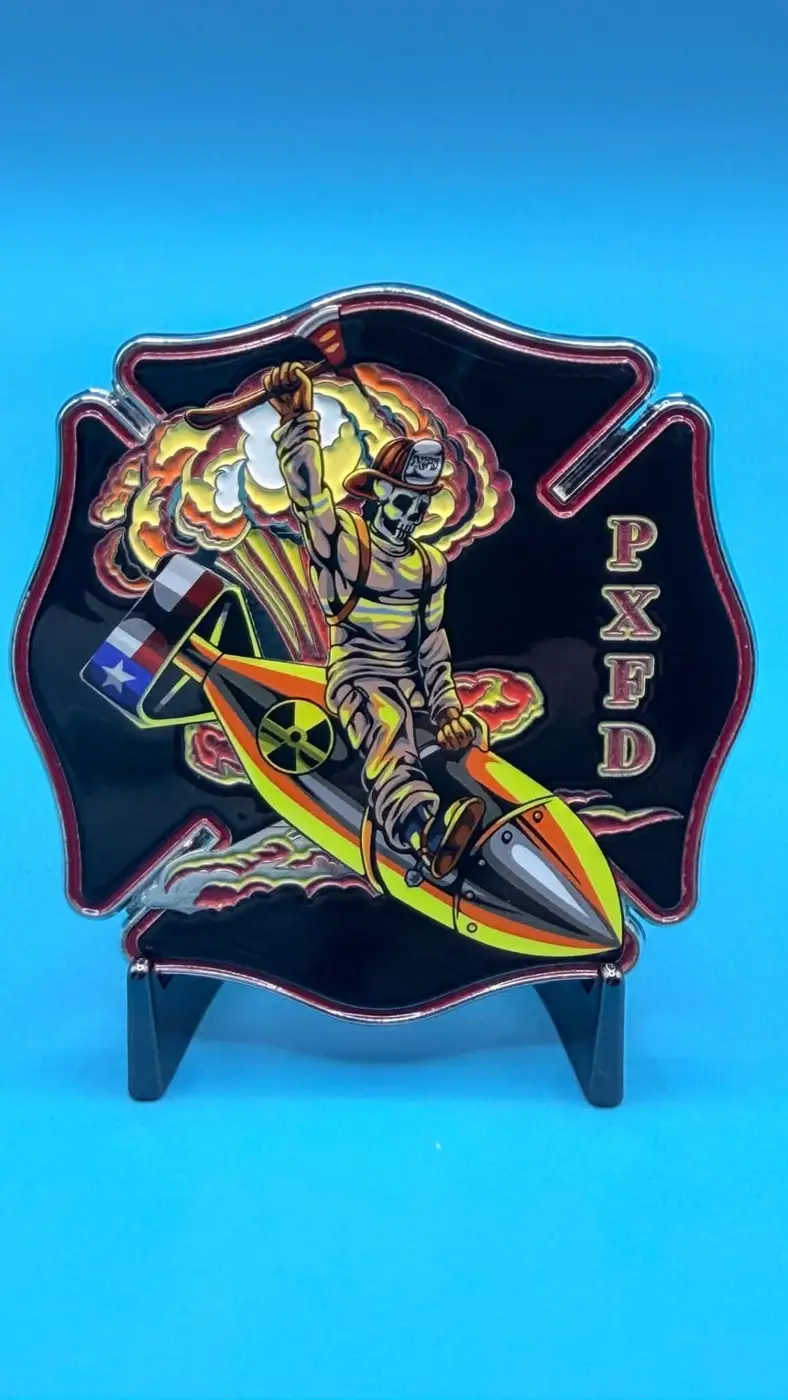
A Maltese cross cut reads as fire service instantly, before anyone looks at the artwork. A shield cut reads as law enforcement or command. A Star of Life reads as EMS. Choosing a custom cut over a round blank does more for recognition than any single detail inside the design.
Remember that a cut shape removes usable surface. Keep lettering out of the arms of a cross and put it on a banner or the rim instead.
Directions that strike well
- Station identity — station number as the dominant element, apparatus silhouette, founding year in glitter or raised metal.
- A sculpted figure — a firefighter, medic, or mascot character in 3D relief, which is where 2.5 inch coins earn their size.
- Hazard discipline — hazmat, bomb squad, and technical rescue coins built around the discipline's own symbol rather than a generic flame.
- Humour and mascots — nicknames and crew characters are some of the strongest coins we strike, because the department already recognises them.
- Memorial coins — a name, dates, and a single restrained emblem. These want polish and depth, not extra colours.
Effects worth using
Glow-in-the-dark enamel is a natural fit for fire service coins and genuinely surprises people the first time. Glitter enamel gives fire and heat texture without extra colours. Antique plating settles into recesses and makes relief read at arm's length, while polished plating throws highlights.
Use one effect as the hook rather than three at once. Coins with a single striking treatment look intentional; coins with everything look busy.
What loses detail in a die
Photographic gradients, hairline outlines, small drop shadows, and long paragraphs of tiny text all fail once translated into metal. So does very thin lettering inside a narrow band. If a detail is smaller than a grain of rice on the finished coin, it will fill or vanish.
The fix is not to simplify your idea, it is to redraw it for a die. That is what we do before proofing: keep the concept, rebuild the linework at the weight the press can hold.
Bring what you have
A patch photo, an old coin, a helmet decal, or a sketch on the back of a run report is enough to start. You approve a digital proof before any die is cut, and nothing is struck until you sign off on it.
Ready to price your own coin?
Build the exact specification — size, thickness, plating, enamel, effects — and we will come back with a real figure for your run.
Get a free quote