Military Challenge Coins: A Design Guide for Units and Commands
Unit coins carry insignia, history, and identity in metal. Here is how Army, Air Force, Marine, Navy and joint commands design challenge coins that members actually keep.
What a military challenge coin represents
In the military a challenge coin is more than a keepsake. It is a physical record of belonging: a squadron, a battalion, a deployment, a command, a course, or a mission. The best coins are designed so that anyone who has been there recognises the reference instantly, while outsiders see only a well-made medallion.
The tradition runs through every branch. Army unit coins often carry the unit crest, motto, and campaign streamers. Air Force squadron coins lean hard on aircraft silhouettes, tail flashes, and callsigns. Marine coins tend to be bold and direct. Navy coins reference ships, anchors, and rate symbols. Joint commands and task forces blend multiple branch emblems into one design.
Design elements that read as military
Military coins have their own visual language. These are the elements that signal authenticity at a glance:
- Unit crest, shield, or patch rendered as the central device.
- Motto, nickname, or callsign around the rim or across a banner.
- Dates — founding year, deployment window, graduation class, operation name.
- Rank, rate, or position marker when the coin marks a billet.
- Branch colour hints in enamel or plating without over-explaining.
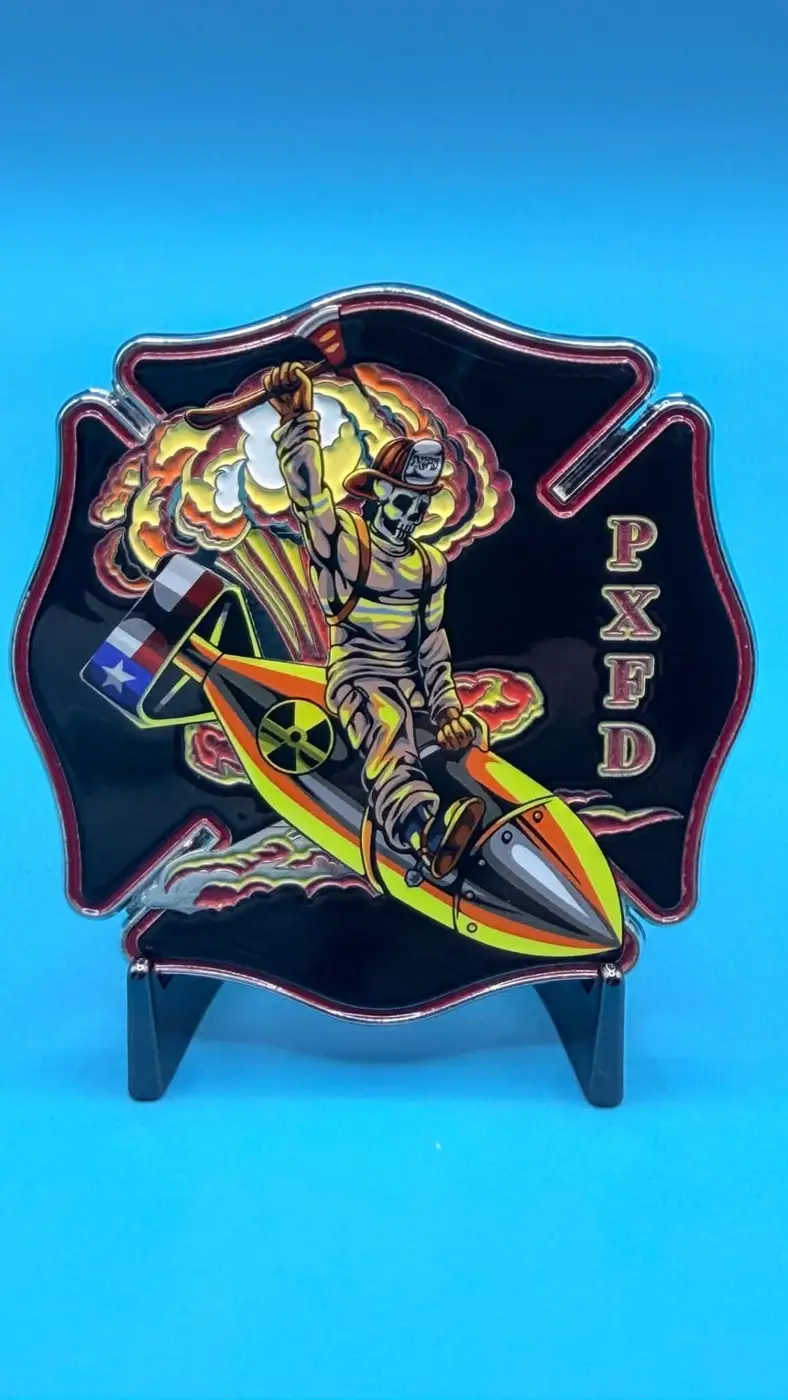
- 3D relief for crests, aircraft, vehicles, or figures that need to read in the hand.
Size, shape and finish choices
Most military unit coins are struck between 1.75 and 2.5 inches. A 2-inch coin is easy to carry and still carries enough detail for a crest and motto. A 2.5-inch coin is the presentation size: heavier in the hand, more room for sculpted aircraft or figures, and better suited for commander's coins handed out individually.
Shape follows meaning. Round is standard and classic. Shield shapes read as command or law enforcement. Custom cuts such as dog tags, aircraft outlines, or map silhouettes make the coin unmistakably specific to one unit, but they also reduce usable surface area.
Finish sets the tone. Antique gold and antique silver settle into recesses and make relief read from across a room. Polished plating throws highlights and feels ceremonial. Dual plating — gold and silver together — is common for coins that mark rank or command level.
Common mistakes when designing a unit coin
We see the same errors repeat across services. Avoiding them is most of the design work:
- Too many elements. A coin is not a poster. One central device, one motto, one date, and one border treatment is usually enough.
- Text smaller than a grain of rice. Tiny unit designators fill in during striking and become illegible.
- Photographic gradients or drop shadows. These do not translate into metal.
- Conflicting branch colour conventions. A small accent is enough; the whole coin does not need to be branch-coloured.
- Forgetting the back. The reverse is a clean place for a commander's name, a date, or a unit value statement.
Commander's coins and presentation pieces
A commander's coin is a smaller run, often numbered, and usually finished to a higher standard than a general unit coin. These are handed out personally, one at a time, and the recipient knows it did not come from a bulk box. Numbering, serialisation, and a thicker 4mm edge are common upgrades.
Presentation pieces — retirement coins, farewell coins, coins for a change of command — can be larger, up to 3 inches, and are often paired with a case or stand. The goal is permanence. These coins are not carried daily; they are displayed.
Why this matters to us
Jericho Seven is a family-run shop. The owner has nearly two decades in the fire service, and his two sons are currently serving in the Air Force and Army. We understand that a unit coin is not just metal and enamel — it is a unit's reputation pressed into someone's palm.
We redraw artwork for striking, send digital proofs before any die is cut, and strike every coin from a custom die with hard enamel and 3D relief. If you are designing a coin for your unit or command, send us your patch, crest, or sketch and we will build a proof that holds up in the hand and in the photograph.
Ready to price your own coin?
Build the exact specification — size, thickness, plating, enamel, effects — and we will come back with a real figure for your run.
Get a free quote