What Is a Challenge Coin?
A challenge coin is a small struck medallion carried to prove membership, mark an achievement, or recognise someone for work that mattered. Here is where the tradition comes from and how it is used today.
The short answer
A challenge coin is a custom-made metal medallion, usually between 1.5 and 3 inches across, struck from a die cut specifically for one group. It is not currency and it is not a souvenir bought off a shelf. It exists to say one thing: the person holding it belongs to something, or did something worth marking.
Coins are carried in a pocket, kept on a desk, or displayed on a stand. Because they are handed over person to person — often in a handshake — they carry weight that a certificate or an email never will.
Where the tradition comes from
The custom is strongest in the military, where unit coins have long been used to identify members of a squadron, command, or deployment. Several origin stories circulate, most of them told and retold within units rather than documented, so treat any single version with care. What is not in dispute is that the practice spread outward from military units.
One widely told story traces the coin challenge to a World War I pilot whose life was reportedly saved by a medallion he carried as proof of identity. Other accounts point to Vietnam-era bars, where service members would slam a coin on the table to prove they had been with a unit. The details vary; the core idea does not: the coin was a physical credential that could not be faked and could not be left behind.
Fire departments, police agencies, hazmat and rescue teams, federal contractors, and civilian companies all use coins now. The purpose stayed the same even as the groups changed: proof of belonging, and a physical way of saying thank you.
Why the tradition still matters
A challenge coin works because it is scarce. You cannot buy one at a gift shop. You receive it from someone who was there, or from an organisation that decided your work was worth the expense of cutting a die, striking metal, and handing it over.
That scarcity is the point. In a world of digital badges and auto-generated certificates, a struck coin is deliberate. It has weight, texture, and a design that took thought. It says the recipient and the moment both mattered enough to be made permanent.
How groups actually use them
The most common uses we see when clients come to us:
- Unit and department identity — every member carries one, new members receive one on joining.
- Recognition — handed over for a specific job done well, often by a commander or chief directly.
- Milestones — anniversaries, station foundings, retirements, final calls, promotions.
- Events — conferences, competitions, mutual-aid operations, joint exercises.
- Trade and collecting — coins swapped between departments and units, then displayed.
The coin challenge
The name comes from a bar tradition. Someone calls a challenge — often by rapping their coin on a table — and everyone present must produce theirs. Whoever cannot is on the hook for the round. Rules vary by unit, and each group treats its own version as the correct one.
It sounds like a game, and it is, but the practical effect is that people carry their coin. That is why build quality matters more than it looks like it should.
What separates a real coin from a token
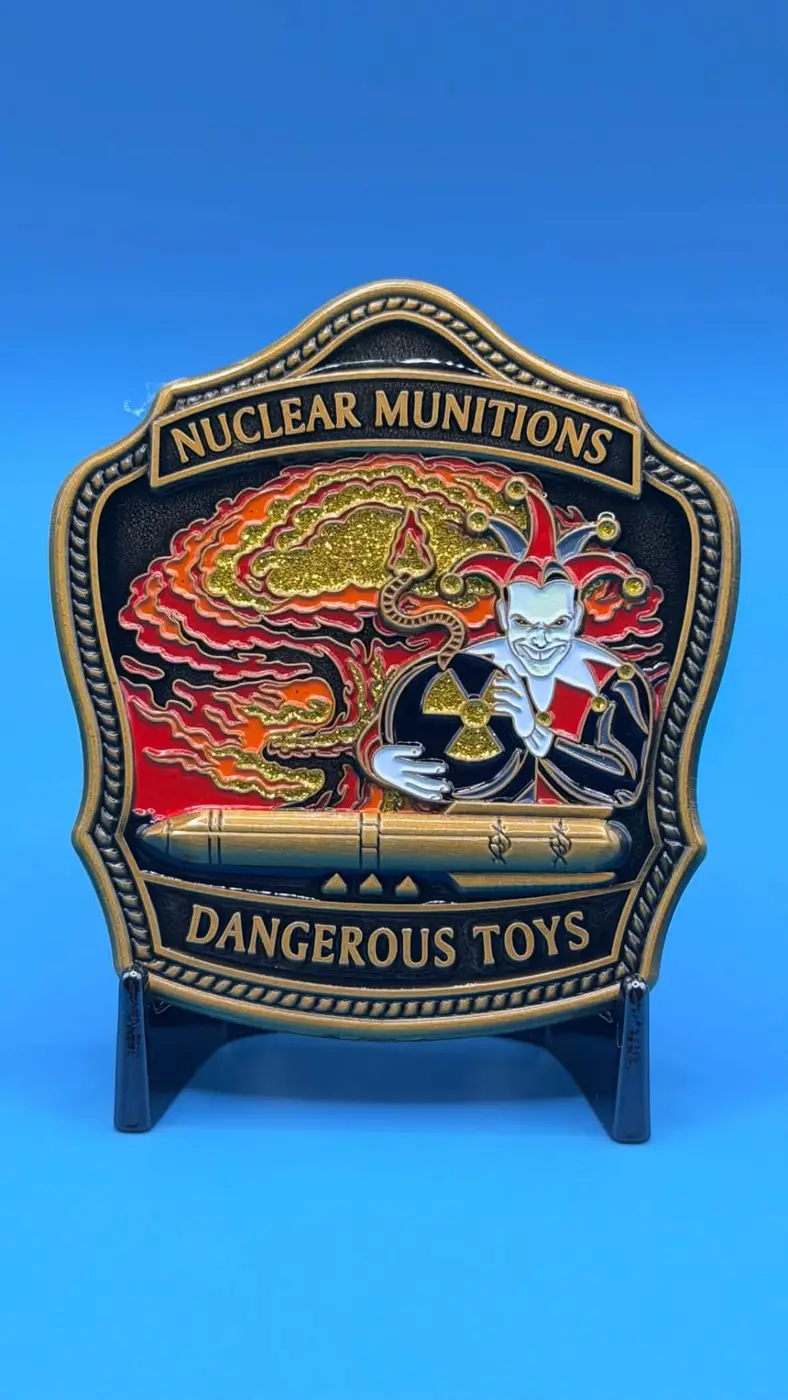
The difference shows up in the hand. A properly struck coin has depth — sculpted relief you can feel, enamel set into recessed metal rather than printed on top, a defined edge, and enough thickness to feel substantial rather than tinny.
Thin flat coins with printed colour photograph acceptably and disappoint in person. Every coin in our gallery is struck from a cut die with hard enamel and real 3D relief, which is why the macro photographs hold up at that magnification.
From our shop
Jericho Seven is a small shop run by someone with nearly twenty years in the fire service and two sons currently serving in the Air Force and Army. We design and strike coins for fire departments, military units, law enforcement, and federal contractors. The work matters because the people who receive these coins matter. That is the standard we cut every die to.
Ready to price your own coin?
Build the exact specification — size, thickness, plating, enamel, effects — and we will come back with a real figure for your run.
Get a free quote